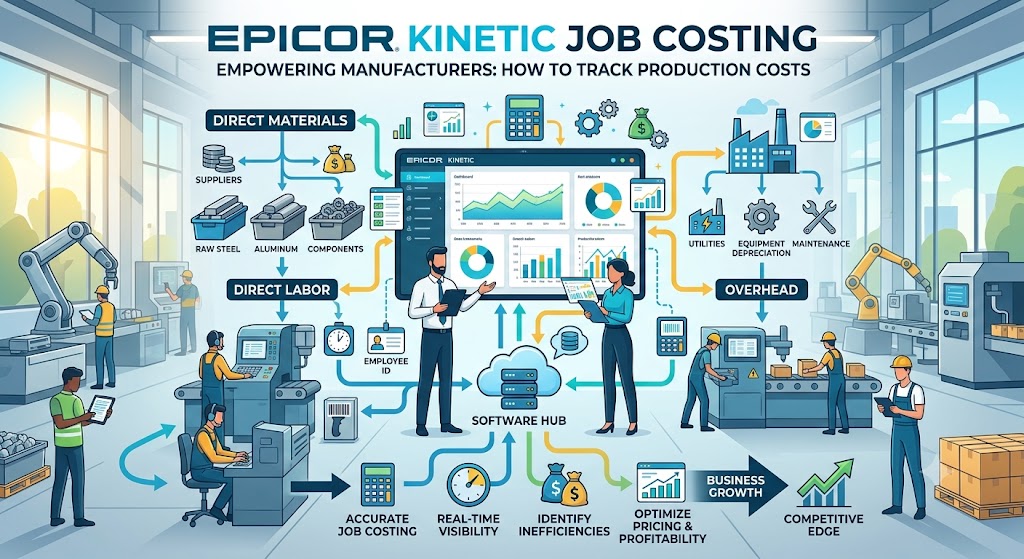








Manufacturing companies need accurate cost information to protect profit margins, manage resources, and deliver customer orders efficiently. However, tracking material expenses, labour hours, and production overhead can be difficult when information is spread across spreadsheets and separate systems.
Epicor Kinetic job costing helps manufacturers manage production jobs, review costs, and compare actual expenses with estimates. With connected manufacturing information, businesses can improve cost visibility and make more informed operational decisions.
In this blog, we explore how job costing works, its benefits, and how Epicor Kinetic can support better production cost management.
What Is Job Costing in Manufacturing?
Job costing is a method of calculating the expenses associated with a specific manufacturing order, product, or production job. It helps businesses understand how much it costs to complete individual jobs instead of looking only at total factory expenses.
Manufacturing job costing generally includes three main categories:
- Material costs: Raw materials, components, and other items used in production.
- Labour costs: Employee time spent completing manufacturing operations.
- Manufacturing overhead: Indirect expenses such as equipment maintenance, utilities, and factory operations.
Tracking these costs helps manufacturers compare planned expenses with actual spending and identify opportunities to improve efficiency.
Why Is Manufacturing Job Cost Tracking Important?
Production costs can change because of material price increases, machine downtime, additional labour, or unexpected rework. Without accurate cost tracking, manufacturers may discover these issues only after completing an order.
Effective job cost tracking helps businesses:
- Monitor production expenses.
- Identify cost overruns.
- Improve quotation accuracy.
- Reduce material waste.
- Understand job profitability.
- Improve production planning.
- Make better pricing decisions.
For manufacturers handling customised orders or complex production processes, these insights can support better financial control.
How Epicor Kinetic Job Costing Helps Manufacturers
Epicor Kinetic provides manufacturing-focused capabilities for job management, production planning, costing, and tracking. Its job management tools help manufacturers compare costs, link orders to jobs, and monitor production activities.
-
Track Costs for Individual Jobs
Every manufacturing job may require different materials, labour, and production operations. Tracking each job separately helps managers understand its costs and financial performance.
Epicor Kinetic supports job-level tracking and helps connect customer orders with manufacturing activities. This can be especially useful for make-to-order, engineer-to-order, and other complex production environments.
-
Improve Material Cost Visibility
Material consumption has a direct impact on manufacturing expenses. Inaccurate inventory records or unexpected material usage can cause actual costs to exceed estimates.
By connecting production and material information, manufacturers can investigate usage differences, review purchasing decisions, and improve future cost estimates.
Accurate bills of materials and production records remain essential for reliable results.
-
Monitor Labour and Production Activities
Labour hours and production operations contribute significantly to the total cost of a job. Manufacturers need consistent records of the time and resources used during production.
Epicor Kinetic supports production tracking and labour reporting capabilities that can help businesses review operational performance. Managers can investigate delays, additional work, or inefficient processes that affect production costs.
-
Compare Estimated and Actual Costs
Cost estimates provide a baseline for planning an order. Comparing those estimates with actual expenses helps manufacturers understand where costs have increased.
For example, a job may require additional material or labour because of a design change or production delay. Reviewing these differences can help managers identify the cause and improve estimates for future orders.
-
Connect Production and Financial Information
When production, inventory, and finance teams work with disconnected records, understanding total job costs becomes more difficult.
An integrated ERP environment helps bring business information together for more consistent reporting and analysis. Epicor Kinetic supports connected manufacturing and financial processes, although specific costing workflows depend on system configuration.
Example: How Job Costing Identifies Production Cost Overruns
Consider a manufacturer producing a custom industrial component.
| Cost category | Estimated cost | Actual cost |
| Materials | ₹50,000 | ₹57,000 |
| Labour | ₹25,000 | ₹29,000 |
| Overhead | ₹25,000 | ₹29,000 |
| Total | ₹1,00,000 | ₹1,15,000 |
The actual production cost is ₹15,000 higher than estimated, representing a 15% increase.
By reviewing each cost category, the manufacturer can investigate whether the difference resulted from material prices, additional labour, or overhead expenses. This example is illustrative and does not represent a reported Epicor customer result.
Best Practices for Better Manufacturing Cost Control
Manufacturers can improve job costing accuracy by following these practices:
- Maintain accurate records: Keep bills of materials, production routings, and material transactions updated.
- Record labour consistently: Assign production time to the correct jobs and operations.
- Define overhead rules: Use consistent methods to allocate indirect production expenses.
- Review cost variances: Investigate differences between estimated and actual costs regularly.
- Improve collaboration: Help production, inventory, procurement, and finance teams work with consistent information.
- Use historical data: Review completed jobs to improve future quotations and production estimates.
Technology can support these practices, but reliable costing also depends on accurate data and well-defined business processes.
Why Consider Epicor Kinetic for Job Cost Management?
Manufacturers need clear visibility into production costs to make informed decisions about pricing, resource allocation, and operational efficiency.
Epicor Kinetic offers manufacturing ERP capabilities covering job management, production planning, inventory, and reporting. These capabilities can help businesses connect production activities with cost information and improve operational visibility.
CorporateServe helps businesses explore ERP solutions according to their manufacturing processes and requirements. Learn more about Epicor Kinetic ERP and discuss how it may support your production cost management goals.
Conclusion
Accurate job costing helps manufacturers understand the true expenses associated with individual production orders. By tracking material, labour, and overhead costs, businesses can identify cost overruns, improve estimates, and strengthen financial control.
Epicor Kinetic job costing supports job management, production tracking, and cost analysis within a manufacturing-focused ERP environment. Combined with accurate records and consistent processes, these capabilities can help manufacturers make better decisions and manage production costs more effectively.
Frequently Asked Questions
- What is Epicor Kinetic job costing?
It refers to using Epicor Kinetic’s manufacturing job management and costing capabilities to track and analyse production job expenses.
- What costs are included in manufacturing job costing?
Typical categories include direct materials, direct labour, and allocated manufacturing overhead.
- How does job costing improve profitability?
It helps manufacturers identify cost overruns, improve quotations, reduce waste, and make better pricing and production decisions.
- Can Epicor Kinetic compare estimated and actual costs?
Epicor Kinetic provides job management and costing capabilities that support cost comparison and tracking. Available workflows depend on the system configuration.
- Is job costing useful for custom manufacturing?
Yes. It helps manufacturers track the individual material, labour, and production requirements of customised orders.
- Where can I learn more about Epicor Kinetic?
Visit CorporateServe’s Epicor Kinetic page to explore manufacturing ERP capabilities and discuss your business requirements.