







Choosing the right ERP system is an important decision for any growing business. However, successful ERP transformation depends not only on the technology but also on the team responsible for implementing it. Businesses need an experienced partner who understands their processes, industry requirements, data, and long-term goals.
An experienced SAP Cloud ERP Implementation Partner in India can help organisations plan their ERP journey, configure business processes, migrate existing data, integrate applications, and prepare employees for the new system.
With the right implementation approach, businesses can improve operational visibility, connect departments, and build a stronger foundation for growth.
In this guide, we explain how to choose the right SAP Cloud ERP implementation partner and what businesses should consider before starting an ERP project.
Why Do Businesses Need an SAP Cloud ERP Implementation Partner?
SAP Cloud ERP connects important business functions such as finance, procurement, sales, supply chain, and operations. Implementing it requires more than installing a system. It involves understanding existing workflows and aligning them with the selected ERP environment.
An implementation partner helps businesses:
- Understand their ERP requirements and business objectives.
- Select a suitable SAP Cloud ERP deployment option.
- Plan data migration from existing systems.
- Configure processes according to business needs.
- Integrate SAP with other business applications.
- Test the system before deployment.
- Train employees and support user adoption.
- Manage go-live and post-implementation improvements.
Working with an experienced team can help organisations manage implementation challenges and maintain better control over the project.
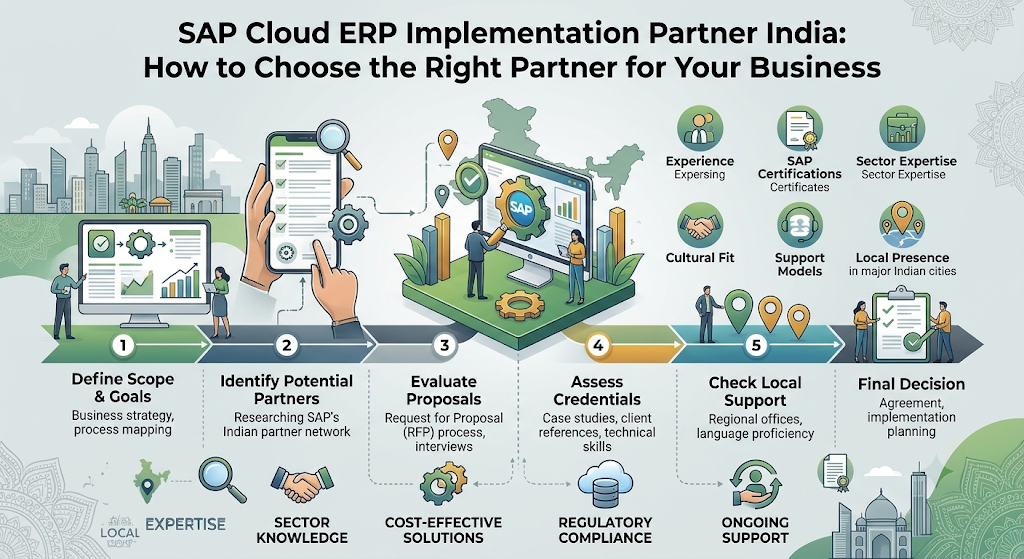
7 Factors to Consider When Choosing an SAP Cloud ERP Implementation Partner in India
Selecting the right partner requires careful evaluation. Here are seven important factors businesses should consider.
-
SAP Expertise and Implementation Experience
Start by reviewing the partner’s SAP experience and understanding of the solution you plan to implement.
Check whether the partner has experience with relevant SAP products, implementation projects, system configuration, migration, and integration.
Ask about previous projects, consultant expertise, project responsibilities, and the types of business requirements they have handled.
-
Industry Knowledge
Different industries have different operational requirements. Manufacturing companies may focus on production planning and inventory, while retail businesses may prioritise purchasing, sales, and supply chain operations.
Your implementation partner should understand the processes relevant to your industry.
Industry knowledge helps the project team identify process requirements and design workflows that support actual business operations.
-
Data Migration Capabilities
Data migration is one of the most important stages of an ERP implementation.
Businesses may need to move information such as customer records, supplier details, product information, financial data, and historical transactions from existing systems.
A capable implementation partner should have a clear approach to:
- Reviewing existing data quality.
- Identifying duplicate or incomplete records.
- Mapping data to the new system.
- Performing migration tests.
- Validating migrated information.
- Reconciling data before go-live.
Proper data preparation helps reduce errors and supports a smoother transition.
-
System Integration Expertise
Most businesses use multiple applications for finance, reporting, customer management, warehouse operations, and other activities.
An SAP Cloud ERP implementation partner should understand how to connect the ERP environment with relevant business applications.
Good integration planning helps reduce disconnected information, minimise manual data entry, and improve coordination between departments.
-
Clear Project Planning and Governance
ERP implementation involves multiple teams, activities, deadlines, and business decisions.
Before selecting a partner, understand how they manage project scope, responsibilities, risks, timelines, testing, and communication.
A structured project plan helps everyone understand their role and reduces confusion during implementation.
-
Employee Training and Change Management
A new ERP system can change how employees perform their daily tasks. Even a well-configured system may face adoption challenges if users are not properly trained.
The implementation partner should include user training, documentation, process guidance, and change management in the project plan.
Preparing employees before go-live helps businesses improve system adoption and reduce operational difficulties.
-
Post-Go-Live Support and Optimisation
ERP implementation does not end when the system goes live. Businesses may need assistance with issue resolution, performance reviews, process improvements, and system updates.
Before choosing a partner, clarify what support is available after deployment and how ongoing requirements will be managed.
Understanding SAP Cloud ERP Public and Private Editions
Choosing the right deployment option is another important part of ERP planning.
SAP Cloud ERP Public Edition generally supports standardised cloud processes and a structured approach to implementation. It can be suitable for businesses looking to adopt established best-practice workflows.
SAP Cloud ERP Private Edition offers a different level of flexibility and can be relevant for organisations with more complex requirements or existing ERP environments to consider.
The right option depends on business size, process complexity, existing systems, integration needs, and future plans.
An experienced partner can assess these requirements and help businesses evaluate the appropriate deployment approach.
SAP Cloud ERP Implementation Process: Step by Step
A structured implementation process helps businesses prepare for the transition.
- Enterprise Readiness Assessment: Review existing systems, business processes, requirements, and potential challenges.
- Solution Blueprinting: Design workflows and define how SAP Cloud ERP will support business operations.
- Implementation and Migration: Configure the solution and prepare business data for migration.
- System Integration: Connect SAP with relevant applications and business systems.
- Testing and Training: Validate processes, check data accuracy, and prepare employees.
- Go-Live and Optimisation: Deploy the system, support users, resolve issues, and identify opportunities for improvement.
The exact project timeline depends on business complexity, data quality, integration requirements, and the selected deployment option.
Why Consider CorporateServe as Your SAP Cloud ERP Implementation Partner in India?
CorporateServe provides SAP Cloud ERP implementation and transformation services for businesses looking to modernise their ERP environment.
Its SAP service offerings include:
- SAP Implementation: End-to-end implementation across Public & Private environments.
- SAP Upgrade and Migration: Transition from legacy or existing ERP environments to modern SAP solutions.
- SAP Rollouts: Extend established SAP processes to additional plants, branches, and business locations.
- System Integration: Connect SAP with relevant business applications.
- Analytics and Reporting: Support reporting, dashboards, planning, and forecasting through SAP Analytics Cloud.
CorporateServe follows a structured approach covering readiness assessment, solution blueprinting, implementation and migration, testing, training, change management, go-live, and optimisation.
With more than two decades of ERP experience and SAP partnership credentials, CorporateServe helps organisations plan their ERP transformation around their business requirements.
Learn more about CorporateServe SAP Cloud ERP solutions and explore its SAP Cloud ERP implementation services.
Conclusion
Choosing the right SAP Cloud ERP Implementation Partner in India is an important step towards a successful ERP transformation. Before deciding, businesses should evaluate SAP expertise, industry knowledge, migration capabilities, integration experience, project governance, employee training, and post-go-live support.
A structured implementation approach helps organisations manage risks, align processes, and prepare employees for the new ERP environment.
If your business is planning to adopt SAP Cloud ERP, working with an experienced implementation team can help turn your technology investment into a stronger foundation for connected and efficient business operations.
Frequently Asked Questions (FAQs)
- What does an SAP Cloud ERP implementation partner do?
An implementation partner helps businesses assess requirements, design processes, configure SAP, migrate data, integrate systems, test workflows, train employees, and manage go-live.
- How do I choose the right SAP Cloud ERP implementation partner in India?
Evaluate the partner’s SAP expertise, industry experience, migration capabilities, integration knowledge, project management approach, training services, and post-go-live support.
- What is the difference between SAP Cloud ERP Public and Private Edition?
Public Edition focuses on standardised cloud processes, while Private Edition can offer more flexibility for organisations with specific requirements. The right option depends on business needs and the selected SAP offering.
- How long does SAP Cloud ERP implementation take?
The timeline varies depending on project scope, business complexity, data migration, integrations, testing, and deployment requirements. A detailed assessment helps establish a realistic project schedule.
- Why is data migration important in SAP Cloud ERP implementation?
Data migration transfers important business information from existing systems. Proper data cleansing, mapping, testing, and validation help maintain accuracy during the transition.
- Does CorporateServe provide SAP Cloud ERP implementation services?
Yes. CorporateServe lists SAP Cloud ERP implementation across public and private environments, along with migration, integration, rollouts, analytics, and reporting services